



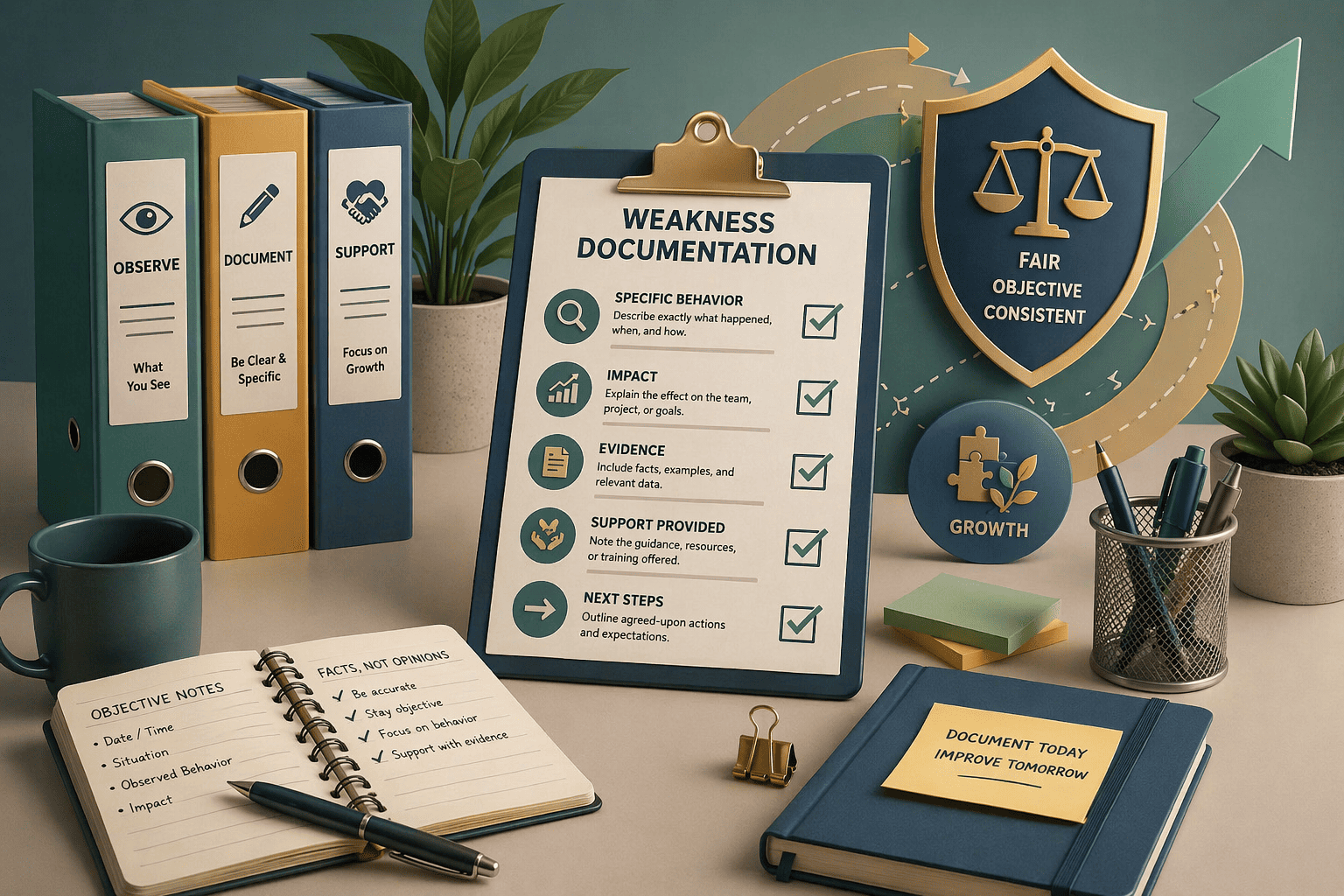
How managers should document weaknesses fairly is a question most performance conversations skip. Documentation is usually framed as legal protection for the company — and it is — but fair documentation of employee weaknesses also protects the employee. It protects them from rating bias, from being managed out without clear evidence, and from being blindsided at review time. This guide covers what African managers in Nigeria, Kenya, and Ghana need to write, how to write it, when to share it, and what to avoid.
It protects them from rating bias: a manager who has documented specific, dated examples of a performance gap cannot inflate or deflate a rating on the basis of impression. It protects them from being managed out unfairly: a documented development plan gives them a clear standard to meet and an evidence trail that shows whether they met it. And it protects them from surprise: if the documentation exists and is shared, the employee knows exactly where they stand.
Performance documentation best practices for African managers require attention to what to write, how to write it, when to share it, and what to avoid in Nigerian, Kenyan, and other African company contexts.
The four properties that make weakness documentation fair and defensible
1. Factual, not interpretive
The most common documentation failure is writing interpretations of behaviour as though they are facts. "John has a bad attitude" is not factual. "In three of the last four team meetings, John responded to questions from colleagues with one-word answers and looked away while they were speaking" is factual.
The practical rule: if you cannot point to a date, a behaviour, and an observable outcome, you do not have a fact. You have an impression. Impressions cannot be used in formal performance documentation without creating bias and fairness problems.
2. Specific, not general
"Fatima needs to improve her communication" is a general statement that gives Fatima no information about what to change. "In the September client meeting, Fatima provided project status information without reference to the specific timelines the client had asked about, resulting in a follow-up call to clarify that consumed 90 minutes of the project lead's time" is specific enough to act on.
Specificity is also what makes documentation defensible. A general complaint about communication is difficult to sustain if the employee disputes it. A specific incident with a date and an outcome is much harder to contest.
3. Pattern-based, not incident-based for formal documentation
A single incident should not become formal performance documentation unless it is serious enough to warrant immediate action (misconduct, policy violation). For developmental weaknesses, documentation should reflect a pattern: at least two or three dated incidents that show the same gap recurring across different contexts.
One missed deadline is a coaching moment. Three missed deadlines on three different projects in the same quarter is a pattern. Only the pattern belongs in formal performance documentation.
4. Proportionate and paired with a development response
Fair documentation of a weakness includes not just the gap but the organisation's response to it: what support was offered, what the development plan looks like, and what the timeline for improvement is. Documenting employee performance gaps without recording the support offered creates a one-sided account that undermines the integrity of the full performance management process.
What to write and what to avoid
| Situation | Wrong version | Right version |
|---|---|---|
| Communication gap | "Emmanuel is a poor communicator." | "In the October client call, Emmanuel did not address the client's timeline concern directly. The client followed up with the MD the next day asking for clarity." |
| Deadline pattern | "She is always late." | "Deliverables for three of the last four projects (Project A, B, and C) arrived after the agreed deadline. Average delay: four days." |
| Attitude issue | "David has an attitude problem." | "In two separate team meetings in November, David responded to questions from junior colleagues by redirecting the question without answering. Both colleagues raised the experience in their 360 feedback." |
| Quality concern | "Her work is not good enough." | "The Q3 budget report submitted on 14 October contained three calculation errors identified during the review process. This followed a similar pattern in the Q2 report." |
| Development gap | "He needs to develop leadership skills." | "In the three team sessions where Daniel was asked to facilitate, two concluded without agreed next steps. Facilitating to a conclusion is a gap he and his manager have agreed to work on in Q1." |
The documentation process: when and how to record
Document close to the event, not at review time
The most common documentation failure is attempting to reconstruct a performance history at the end of the cycle from memory. Memory is not reliable, and reconstructed documentation is almost always detectable and often legally indefensible.
The practical standard: within 48 hours of any notable performance event, positive or negative, the manager should make a brief note. Date, what happened, what was said, what was agreed. This does not need to be a formal document. A dated email to yourself, a note in the performance management system, or a brief summary kept in a secure folder is sufficient.
Talstack's Performance Reviews module supports this directly: managers can record check-in notes, link them to specific goals, and build a documented performance history throughout the cycle rather than reconstructing it under time pressure at review time.
Share the documentation with the employee, not just HR
Fair documentation is not secret documentation. When a manager records a performance gap, the employee should be aware of it, either because it was discussed in the conversation that produced the note, or because the manager follows up after documenting it.
"After our conversation last week about the timeline on Project X, I made a brief note to record what we discussed and the plan we agreed. I wanted you to know that exists and that it is part of your performance record for this cycle."
This transparency does several things: it confirms the manager's account is accurate, it prevents the employee from being surprised at review time, and it creates a shared record that both parties own.
Include the employee's response, not just the manager's observation
Fair documentation records not just what the manager observed but what the employee said in response. If the employee had context that explained the incident, that context belongs in the record. If they disputed the characterisation, that should be noted too.
"[Date]: Discussed missed deadline on Project B with Yetunde. She explained that the delay was partly caused by a late input from the procurement team that was not flagged to the project lead. She agreed that she should have escalated the dependency risk earlier and committed to doing so on future projects. Next check-in scheduled for [date]."
This format is fair, specific, and complete. It does not hide the gap but it also does not ignore relevant context.
African-specific documentation considerations
In Nigerian and Kenyan companies, several factors complicate fair weakness documentation:
- Verbal-first cultures: In many organisations, performance conversations happen verbally and informally. Managers who have always managed this way may feel that documentation is a sign of distrust rather than good process. The reframe for these managers: documentation is not distrust. It is respect for the employee's right to a clear, accurate record of where they stand.
- Power-distance dynamics: An employee who is managed by someone with significant seniority may feel unable to dispute documentation they disagree with. HR should create an explicit channel for employees to add a brief comment to their own performance documentation if they believe a fact has been recorded inaccurately.
- Sparse HR infrastructure: In companies without a performance management system, documentation tends to live in managers' email inboxes or personal folders and is inaccessible to HR when needed. Establishing even a simple shared Google Doc or a structured email archive policy creates more institutional visibility without requiring expensive tooling.
Quick checklist: is this weakness documented fairly?
- The observation describes a specific behaviour or outcome, not a personality or character trait
- At least two dated examples are included for a developmental pattern
- The employee was aware of the concern when it was raised, not just when it was documented
- The employee's response or perspective is reflected in the note
- A development plan or support offered by the manager is referenced
- The documentation would be defensible if reviewed by HR or, in a serious case, a labour tribunal
Frequently asked questions
What language should managers avoid in weakness documentation?
Avoid all adjectival and character-based language: lazy, difficult, aggressive, disrespectful, unprofessional. These words describe a type of person, not a behaviour. Also avoid always and never, which are rarely literally true and weaken the credibility of a specific, evidenced observation. Avoid subjective interpretations of intent: "she clearly does not care" is an interpretation. "She submitted the deliverable three days late without notifying the project lead" is an observation.
Should weakness documentation be shared with the employee's next manager if they transfer?
Performance documentation that is accurate, dated, and specific should accompany an employee's record if they transfer internally. However, informal impressions, undocumented allegations, or documentation that was never shared with the employee should not be transmitted. The principle is that the employee should not arrive in a new role already defined by a record they did not know existed and could not contest.
What happens if an employee disputes documented weakness?
The employee should have the opportunity to add their perspective in writing to the record. HR should review disputed documentation to ensure it meets the factual, specific, and proportionate standard. If the documentation does not hold up under that review, it should be revised. If it does, the employee's disagreement becomes part of the record and the process continues. The existence of a dispute is not by itself a reason to remove accurate documentation.
The bottom line
Documentation of employee weaknesses done badly is a legal risk, a fairness failure, and a management credibility problem. Done well, it is one of the most respectful things a manager can do: it creates a clear, shared record of where the employee stands, what support was offered, and what improvement looks like.
The standard is simple: write what happened, not what you concluded about the person. Document close to the event. Share it with the employee. Include their perspective. Pair it with a development response. That combination produces documentation that is fair, defensible, and useful for both the organisation and the individual.
Talstack's Performance Reviews module makes this process structured and accessible: check-in notes, goal tracking, and 360 feedback create a documented performance history throughout the cycle, giving both managers and HR the evidence base they need when formal documentation is required.