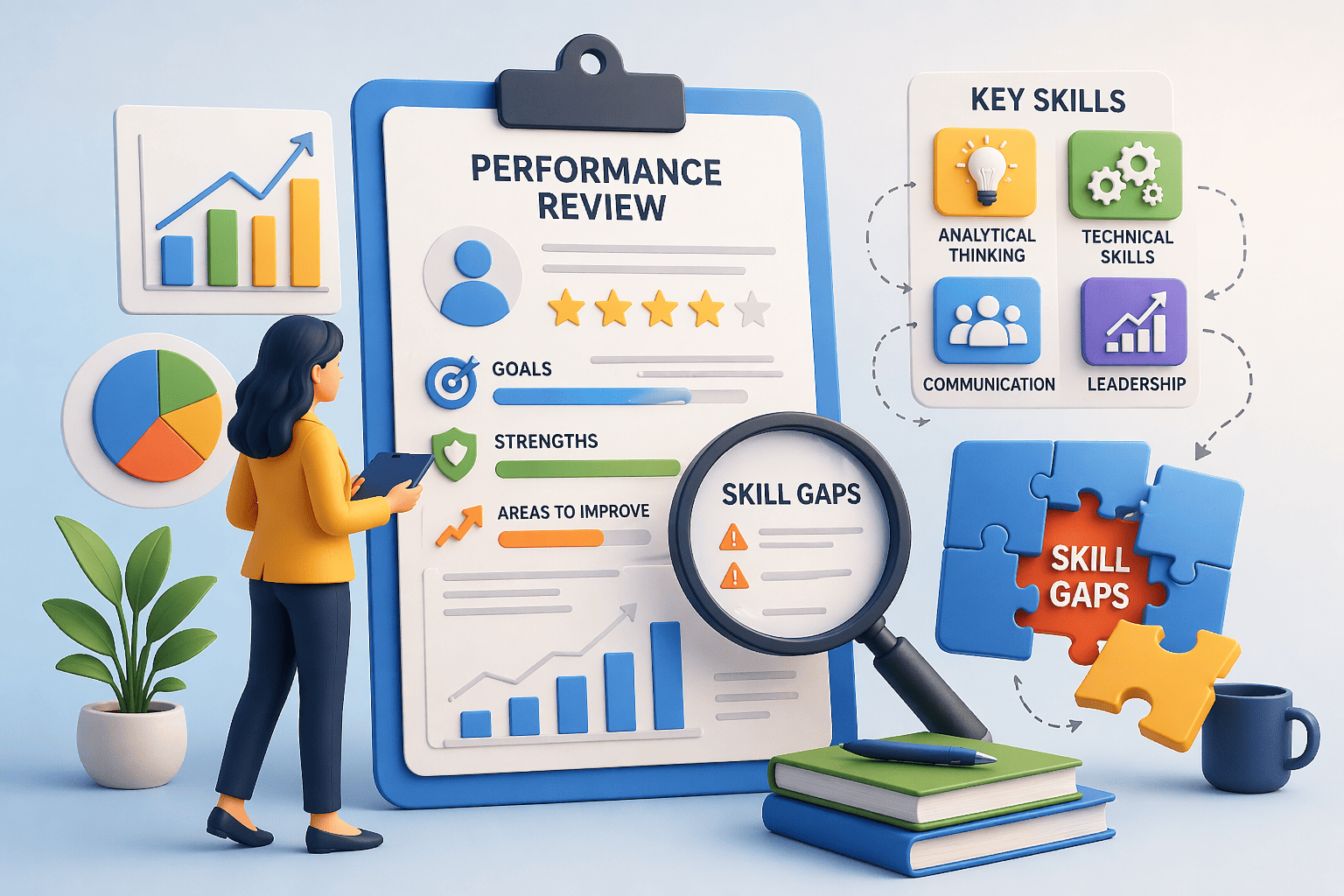
Performance reviews are one of the clearest sources of skill gap data available to HR teams — yet most produce nothing more than a rating form filed away until the next appraisal cycle. If you know how to identify skill gaps from performance reviews systematically, you can build a development plan grounded in actual observed gaps rather than guesswork about what training seems useful. This article explains how to read your review data, distinguish individual gaps from team-wide capability deficits, and turn that analysis into learning investment that gets used.
That is a missed opportunity. A completed performance review contains the best available evidence about where your team's capability is strong and where it is not. A structured skill gap analysis from reviews lets you build a development plan rooted in actual observed gaps rather than assumptions about what training seems useful.
This article explains how to systematically identify skill gaps from performance review data, how to distinguish individual gaps from team-wide capability deficits, and how to turn that analysis into learning investment that gets used.
Why performance reviews are your richest source of skill gap data
Most HR teams in Nigeria, Kenya, and Ghana use performance reviews to produce individual ratings. Fewer use them to surface team capability gaps from performance data — the organisational insights that shape hiring, learning budgets, and management decisions.
The difference is analytical. Individual rating review asks: how did this person perform? Organisational analysis asks: what patterns do these ratings tell us about our team's capability?
According to AIHR's 2026 research on talent management, skills gaps discovered during reviews can guide learning budget decisions and shape recruitment priorities when the data is aggregated across teams. Deloitte's research found that 85% of HR executives have active efforts under way to map skills within their organisations. The data from performance reviews is often the richest source available for that mapping.
In many African companies, this analysis does not happen because the data is scattered across individual manager forms, there is no central place to see patterns, and HR does not have the time or structure to do the aggregation manually.
Three types of skill gaps your reviews reveal
1. Individual skill gaps
These appear when a single employee is consistently rated below the expected level on a specific competency across multiple review cycles. An individual gap is a development planning problem: it tells you what that person needs to learn, whether through a course, a stretch assignment, or coaching.
Individual gaps are the most common output of performance reviews. Most HR teams respond to them with a training course recommendation. That works for technical skills. For behavioural skills like leadership, communication, or planning, on-the-job learning usually works better than classroom training.
2. Team-wide gaps
These appear when the same competency is rated below expectations across multiple employees in the same team or function. A team-wide gap is a systemic problem: it might indicate a hiring pattern (the team was built without this capability), a management pattern (the manager has never prioritised this), or an organisational design issue (the role does not give people the opportunity to develop this skill).
Team-wide gaps are more expensive and more urgent than individual ones. They cannot be fixed by sending one person on a course.
3. Emerging gaps
These appear when competencies that previously rated well begin to decline across a team, often in response to a business context change. If your Nigerian fintech company recently moved from a local payment product to a cross-border one and collaboration scores drop across the operations team in the following review cycle, that is an emerging gap driven by a new complexity the team was not prepared for.
Emerging gaps require the fastest response because they are connected to a live business change. The capability deficit is costing the business now, not hypothetically in the future.
How to read performance review data for skill gap signals
If your performance review system produces ratings across multiple competencies for every employee, you have a usable dataset. Here is how to analyse it.
Step 1: Aggregate ratings by competency, not by employee
Instead of looking at an individual employee's rating form, look at all ratings on one competency across all employees. Sort them by team, by role level, and by manager.
Ask: is there a competency where the average rating is significantly lower than others? Is there a team where a specific competency consistently scores below the organisation's average?
Step 2: Look at the narrative comments
Ratings give you a number. Comments give you the reason. If five employees in the same department received below-expectations ratings on planning and organisation, and four of their manager comments mention "responds to urgency but does not anticipate", that is a team-wide gap in proactive planning, not five individual failings.
HR should read a sample of comments for any competency with a low average rating. The language in the comments often reveals whether the gap is an individual capability issue or a systemic one.
Step 3: Track the same competency across multiple cycles
A single-cycle low rating on a competency might be an anomaly caused by a difficult project, a team restructure, or a poor calibration decision. A low rating that persists across two or three cycles is a genuine gap that the organisation has not addressed.
Step 4: Distinguish capability gaps from clarity gaps
Not every low rating is a skill problem. Some are role clarity problems: the employee did not know what was expected. Some are resource problems: the employee did not have the tools or authority to perform. Before investing in training for a skill gap, confirm that the gap is actually a capability deficit and not a system or management failure in disguise.
Turning the gap analysis into a development plan
Once gaps are identified, the development response should match the type and scale of the gap.
Skill Gap Response Table
| Gap type | Signal in review data | Root cause to check | Development response |
|---|
| Individual capability | One employee consistently below on a specific competency | Skill has not been developed; limited experience in this area | Individual learning plan; Talstack Learning Path; stretch assignment |
| Team-wide capability | Multiple employees in same team below on same competency | Hiring gap; manager has not prioritised this skill; no structured development | Team training programme; manager coaching; structured group learning |
| Clarity gap | Below rating on a competency; comments mention confusion about expectations | Expectations not clearly defined for this competency | Redefine expectations; share examples; recalibrate manager training |
| Emerging gap | Competency that rated well is declining across multiple cycles | Business context has changed; team has outgrown current capability | Urgent team learning; reassess role requirements; consider hiring |
| Leadership pipeline gap | High performer in current role; low potential rating for next level | Leadership capabilities not developed; no exposure to management responsibilities | Succession planning; targeted leadership development; mentoring |
How to use Talstack for skill gap identification
The core challenge with skill gap analysis in most African companies is data fragmentation. Performance review forms live in email, check-in notes live in notebooks, and development plans live in spreadsheets that nobody updates.
Talstack's Competency Tracking feature allows HR to define role-specific competencies, collect ratings against them through the review cycle, and see patterns across teams and departments in one view. When a competency consistently scores below target across a team, that signal is visible to HR in the analytics dashboard without manual aggregation.
The workflow from gap to action is direct: the gap identified in the review dashboard can be linked to a course from Talstack's 300+ course catalogue or a structured Learning Path for the relevant skill, assigned to the relevant employees in a few clicks.
Quick checklist: skill gap identification process
- Performance review ratings aggregated by competency, not just by employee
- Narrative comments reviewed for the lowest-rated competencies
- Same competency tracked across two or more review cycles before labelling it a gap
- Distinction made between capability gap and clarity/resource gap
- Individual gaps assigned to individual development plans
- Team-wide gaps escalated to manager coaching and structured learning response
- Development actions from gap analysis connected to a named owner and a timeline
Frequently asked questions
How do you identify skill gaps without a formal competency framework?
Even without a formal framework, performance review comments contain skill gap signals. Read a sample of below-expectations narratives and note recurring themes. If five managers independently mention "does not plan ahead" or "reactive rather than proactive" about different employees, you have identified a gap worth addressing at the team level. The analysis does not require a formal framework; it requires someone to read the data.
How do you prioritise which skill gaps to address first?
Prioritise by business impact and scale. A skill gap that affects a team responsible for a critical business function is more urgent than one in a support role. A team-wide gap is more urgent than an individual gap. A gap that is causing current output problems is more urgent than one that will matter in 18 months. Apply those three criteria to rank the gaps identified from the review cycle and address the top two or three with a real development budget before moving to the rest.
What is the difference between a skill gap and a performance gap?
A skill gap is a missing or underdeveloped capability: the employee does not yet know how to do something. A performance gap is a delivery shortfall: the employee has the capability but is not applying it consistently. The development response is different. Skill gaps require learning. Performance gaps require accountability, goal clarity, and sometimes a root cause investigation into what is preventing the capability from showing up as output.
How do African companies with no L&D budget act on skill gap data?
Budget is real, but most skill gaps have low-cost or no-cost development responses: stretch assignments, cross-functional exposure, internal peer teaching, and structured mentoring. Where a course investment is warranted, platforms like Talstack provide a 300+ course catalogue that is more cost-effective than external training programmes for most business functions. The gap analysis tells you where to invest; the investment does not always have to be expensive.
The bottom line
Every performance review cycle produces a dataset about your team's capabilities. Whether that data creates action depends on whether anyone analysed it.
Aggregating ratings by competency, reading the narrative comments for patterns, and tracking gaps across cycles turns individual rating forms into an organisational capability map. That map tells you where to invest your development budget and who needs what kind of support.
Talstack's Competency Tracking and Analytics features make this process faster and more visible for African HR teams running lean: from review data to gap identification to Learning Path assignment in one workflow, without the spreadsheet overhead that slows most organisations down.