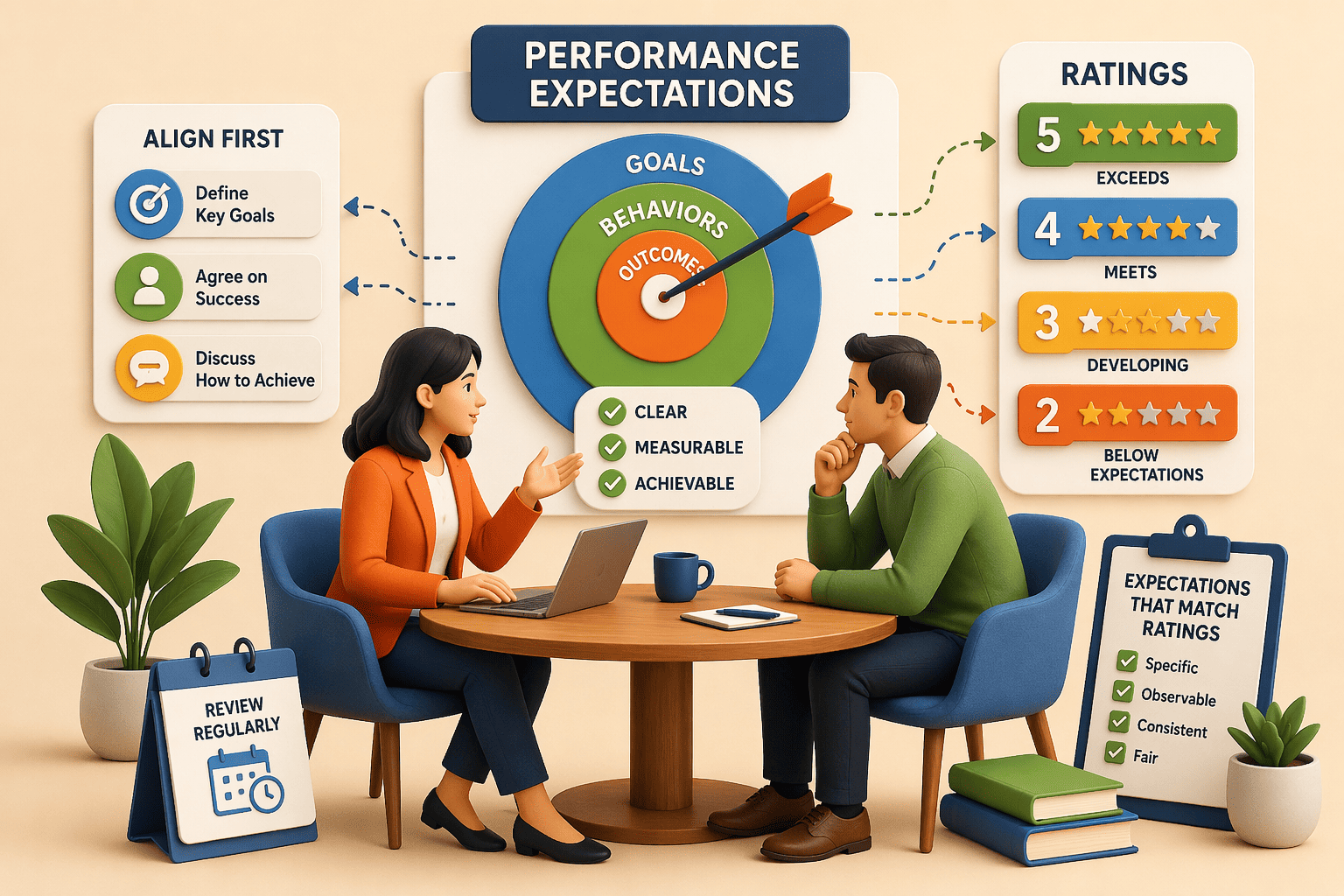
Setting performance expectations that match ratings is the only way to make reviews feel fair. The most common cause of rating disputes is not bias — it is ambiguity. An employee works hard for six months, receives a 'meets expectations' rating, and feels blindsided. That gap exists because nobody defined what 'exceeds expectations' required. This article shows you how to set expectations specific enough that every rating an employee receives is one they could have predicted.
When performance rating expectations are never made explicit, an employee can work hard for six months, receive a 'meets expectations' rating, and still feel blindsided. The manager is confused by the reaction. From their perspective, "meets expectations" is a good rating: the employee did their job.
From the employee's perspective, nobody ever told them what "exceeds expectations" would have required. So they assumed hard work would get them there.
That gap is an expectations problem, not a performance problem. This article explains how to set expectations that connect directly to your rating scale, so that every rating the employee receives was one they could have predicted.
Why vague expectations destroy performance rating credibility — and how clear standards fix it
When performance criteria are vague, ratings become a manager's opinion dressed up as an evaluation. The employee cannot prepare for them, cannot predict them, and cannot learn from them in a useful way.
In Nigerian SMEs, this pattern is especially common. A 2025 analysis of performance management practices across African organisations found that small businesses often struggle with defining clear performance metrics, and that without structured criteria, employee assessments become biased and inconsistent.
Three signals that your expectations are too vague:
- Employees regularly express surprise at their ratings, even when the manager thought the message was clear
- Different managers in the same organisation rate similar performance levels differently because there is no shared definition of "above" vs. "meets"
- Employees ask "what do I need to do to get a higher rating?" and managers cannot answer specifically
The two levels of expectations that must be defined
Level 1: Role expectations
These describe what the role is supposed to deliver. They include the core responsibilities, the quality standards, and the behaviours that define the role at the level it was hired for.
For a content manager at a Lagos-based fintech, role expectations might include: producing two high-quality articles per week on brief, maintaining an average quality score of 7+ from the editorial review, and briefing the design team at least five days before a campaign deadline.
These are not goals. They are the baseline. An employee who consistently meets these expectations "meets expectations."
Level 2: Rating-level definitions
Once role expectations are defined, the rating scale needs to describe what each level looks like in practice, using examples from the role.
A useful format:
- Below expectations: The employee is regularly falling short of the core responsibilities defined for the role. This is not an occasional miss; it is a pattern that persists after the manager has raised it.
- Approaching expectations: The employee meets some of the core criteria but not all. They are developing, but the output or behaviour does not yet consistently meet the role definition.
- Meets expectations: The employee consistently delivers against all core role expectations. This is a strong and valuable performance. It is not a consolation prize.
- Exceeds expectations: The employee consistently delivers against all core expectations AND demonstrates contribution or capability beyond the defined role. This must be evidenced, not assumed.
Telling employees that "meets expectations is a good rating" is not enough. Showing them, with examples, what the difference between meets and exceeds actually looks like in their specific role is what allows them to aim accurately.
How to build role-specific rating anchors
Rating scale definitions become tangible through rating anchors — descriptions of what each level looks like for a specific competency in a specific role. It makes the standard visible and comparable across managers.
The Behaviorally Anchored Rating Scale (BARS) is the most structured version of this approach. It matches each rating point on the scale to a specific example of observable behaviour. Most African HR teams do not need the full BARS methodology, but they can build a simplified version in an afternoon.
Step 1: List the three to five competencies you will rate
Common examples for most roles: goal delivery, quality of work, collaboration, communication, and problem-solving. For management roles, add people development and strategic thinking.
Step 2: For each competency, write one example for each rating level
For goal delivery in a sales role:
- Below expectations: Consistently misses quarterly sales targets by more than 20%. After being informed of the gap, no visible change in approach.
- Approaches expectations: Hits targets in some quarters but not consistently. Responds to coaching but has not yet stabilised performance.
- Meets expectations: Hits quarterly sales targets in three out of four quarters. When misses occur, brings a clear explanation and a corrective plan.
- Exceeds expectations: Consistently hits targets and has also identified and closed a new account category that was not part of the original territory plan.
Step 3: Share the anchors with employees at the start of the cycle
Before the quarter begins, every employee should have access to the rating anchors for their role. This conversation: "here is what meets expectations looks like for you this cycle, and here is what exceeds expectations would require" should happen in the goal-setting meeting, not the rating meeting.
Connecting expectations to OKRs
OKRs (Objectives and Key Results) provide the clearest possible bridge between performance expectations and ratings.
A well-structured OKR tells the employee: here is the direction we are moving, here is what we are trying to achieve, and here is how we will know we succeeded. When ratings at the end of the cycle connect directly to key result attainment, the employee can track their own trajectory from the first day of the quarter.
A useful mapping:
- Key results missed by more than 30% across the set: below expectations
- Key results largely achieved with a few gaps: approaches or meets expectations depending on circumstances
- Key results achieved AND additional contribution beyond the defined OKRs: exceeds expectations
Talstack's Goals module supports this connection directly: OKRs are set at the start of the cycle, progress is tracked mid-cycle, and the completion data feeds into the performance review at the end. Managers are not reconstructing the year from memory; they have a documented trajectory that makes rating conversations faster and less contested.
Table: Expectations-to-rating alignment (template)
| Rating level | What it means | What evidence supports it | OKR attainment signal |
|---|
| Below expectations | Core role responsibilities not consistently met | Documented pattern of missed delivery or quality gaps after coaching | Key results missed by 30%+ across the set |
| Approaching expectations | Role requirements partially met; still developing | Some consistent delivery; gaps in specific areas the manager has raised | Key results partially achieved with notable gaps |
| Meets expectations | Consistent delivery against all core role requirements | Goal completion, quality standards, and behaviours all at the defined level | Key results largely achieved |
| Exceeds expectations | Consistent delivery plus demonstrated contribution beyond the defined role | Goal completion plus at least one specific, evidenced contribution above the role definition | Key results achieved plus additional contribution not in original OKR set |
Quick checklist: expectation-setting quality
- Role expectations (core responsibilities and quality standards) are documented for every role
- Rating-level anchors with examples have been shared with employees before the cycle begins
- Employees can describe, in their own words, what "exceeds expectations" would require for them this cycle
- OKRs or goals are connected to the rating scale at the start of the cycle
- Rating anchors are consistent across managers rating similar roles
- The definition of "meets expectations" has been communicated as a strong, valuable performance level
Frequently asked questions
What is the difference between performance expectations and KPIs?
Performance expectations describe the overall standard the role should consistently deliver. KPIs are the specific, measurable indicators that track performance against those expectations within a given period. Think of expectations as the permanent definition of the job and KPIs as the quarterly proof that the job is being done at the right level.
How do you set expectations for roles that are hard to measure?
Every role has some aspect that can be observed, even if it cannot be easily counted. For a people operations manager, measurable expectations might include: cycle time for HR processes, employee satisfaction scores, and recruitment time-to-fill. Behavioural expectations cover quality dimensions: clarity of communication, reliability of commitments, and quality of documentation. The mix of measurable and observable criteria covers most roles that seem difficult to rate.
What should you do if expectations were not set at the start of the cycle?
Be honest with the employee. Say: "I did not define expectations clearly enough at the start of this cycle, which makes it hard to give you a fully fair rating now. Here is my assessment based on what I observed. Going forward, here is exactly what each rating level will require." That honesty is more credible than pretending the expectations were clear all along.
The bottom line
A rating is only as credible as the expectations it was measured against. If employees could not have predicted their rating at the start of the cycle, the problem is not their performance. It is the system.
Defining role expectations, building rating anchors, and connecting them to OKRs before the cycle begins turns performance reviews from a source of annual anxiety into a predictable, development-focused conversation that employees can prepare for and act on.