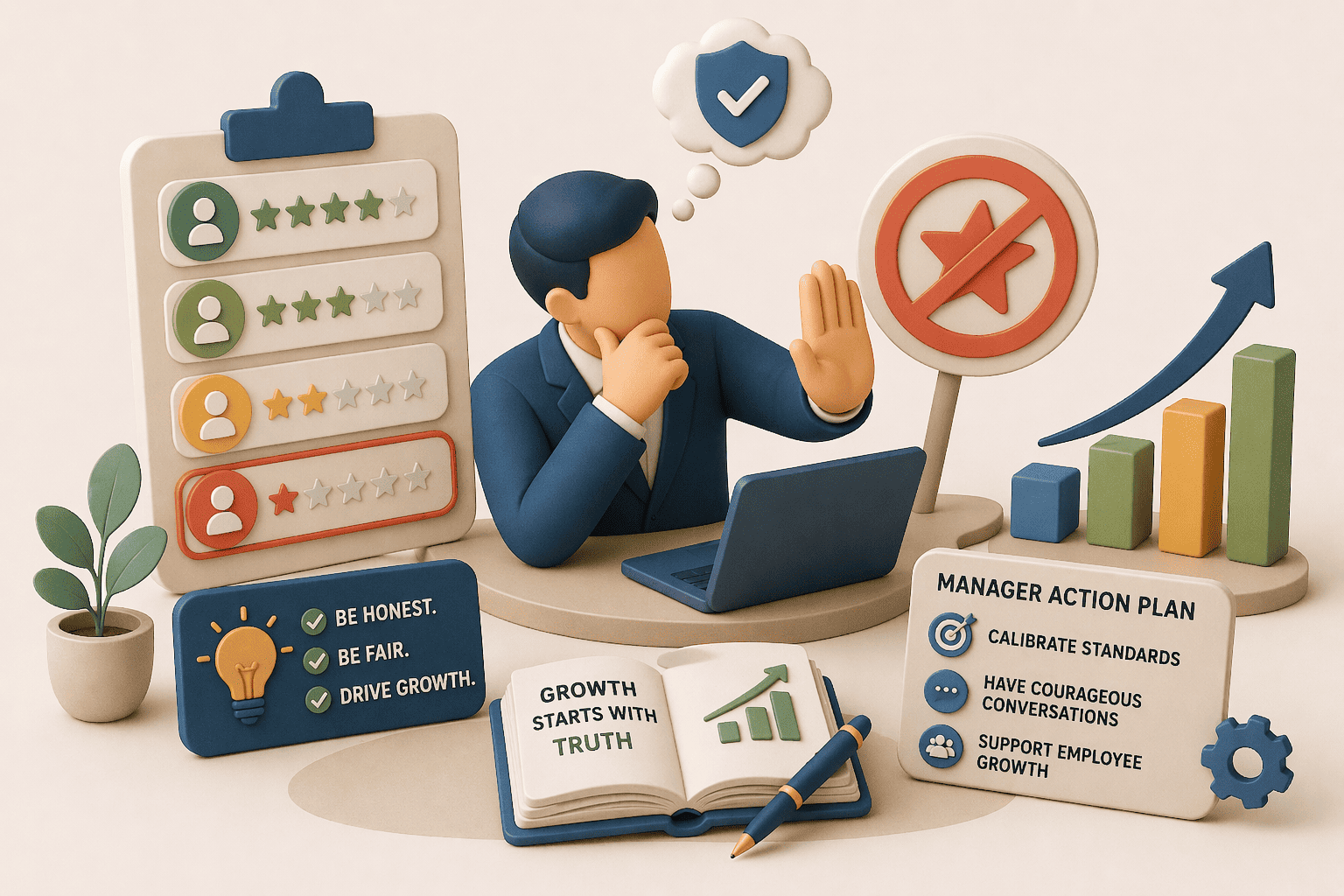
When managers avoid low ratings, the evidence shows up fast. HR pulls distributions after each review cycle and finds 80% of employees rated meets expectations or above, every team looking identical, every manager's spread the same. That is not a distribution — it is manager rating inflation in action. Managers rarely inflate out of malice. They inflate because the system makes honest ratings feel costly: for the relationship, for team morale, for their own credibility as a people leader. This article explains how HR can detect performance rating avoidance, address it structurally, and redesign the conditions that produce it.
That is not a distribution. That is avoidance.
Performance rating avoidance is rarely about malice — managers avoid low ratings because the system makes accurate assessment feel personally and professionally risky.. They are doing so because the system they work within makes honest ratings feel risky: risky for their relationship with the employee, risky for team morale, and risky for their own standing as a people leader. This article explains how to address rating avoidance structurally, not just behaviourally.
Why managers avoid low ratings — and what drives performance rating avoidance
- Conflict aversion: Giving an employee a below-expectations rating is the start of a difficult conversation. Many managers have never been trained to have that conversation confidently
- Relationship protection: In African organisations where teams are small and personal, a low rating can damage a social relationship the manager values
- Compensation anxiety: If ratings connect to pay decisions, a low rating feels like the manager is directly reducing the employee's income
- Fear of dispute: Managers who have experienced a difficult rating dispute previously learn to avoid the situations that produce them by avoiding the low ratings that trigger them
- No consequence for inflation: If HR never challenges inflated distributions, there is no reason for the manager to take on the personal cost of accurate ratings
The cost of rating inflation
According to Engagedly's 2025 research, According to Engagedly's 2025 research, manager rating inflation through leniency bias accounts for approximately 30-40% of the variance in performance ratings in organisations without calibration.. That means nearly a third of performance data may be inaccurate.
The downstream costs are specific:
- High performers who cannot be differentiated from average performers become frustrated and leave
- Underperformers receive no honest signal and no development support
- Succession planning is based on inflated data and produces poor talent decisions
- Legal exposure when a manager later tries to take action against performance that their own reviews rated as satisfactory
Four interventions that reduce rating avoidance
In calibration, HR reviews the distribution of each manager's ratings. A manager who has rated 18 of 20 employees as "meets" or "above" is asked: "What is your evidence for each of these ratings? Are there any employees on this list who you would like to reconsider in the context of this distribution?"
That question, asked consistently in every calibration session, is the single most effective anti-inflation intervention available. It does not blame the manager. It simply creates a moment of reflection in front of peers.
Intervention 2: Separate ratings from compensation decisions in the review conversation
When managers believe their rating directly controls the employee's salary, they feel responsible for the financial consequence of every below-average rating. Structurally separating the rating conversation from the compensation discussion removes some of that psychological load.
"Your rating is a reflection of your performance this cycle. Compensation decisions are made by a separate process that HR manages. Your job right now is to give an accurate assessment of the work."
Manager avoidance of low ratings is often avoidance of the conversation that follows. Training that includes role-play of below-expectations conversations, with practice handling defensiveness and emotion, builds the confidence that makes accurate ratings feel manageable rather than dangerous.
When peer feedback data is available, it provides an independent reference point. A manager who rates an employee above expectations but whose peers rated them as average needs to explain the divergence. That divergence question is harder to avoid than a simple distribution review.
Talstack's 360 Feedback feature produces this peer data as part of the standard review cycle, giving HR and calibrators the multi-source reference they need to challenge inflated ratings with evidence, not just with suspicion.
What to do with a manager who inflates persistently
A single cycle of high distributions might reflect a genuinely strong team. Two cycles of identical high distributions from the same manager is a pattern. Three cycles is a documented problem that requires a direct conversation.
That conversation is between the manager's line manager, not HR alone: "Your review distributions have shown the same pattern for three cycles. This makes it difficult for us to use your review data to make accurate talent decisions. I need to understand how you are applying the rating standards and what I can do to support you in giving more differentiated ratings."
If the pattern continues after that conversation, it is a management competency issue that affects the quality of the team's performance data and eventually, the careers of the employees being misleadingly rated.
Frequently asked questions
Is it possible that a team genuinely is performing at a uniformly high level?
Yes, occasionally. A small, carefully selected team in a high-performing environment may legitimately have most members performing above the average standard. The test: can the manager provide specific evidence for each above-average rating? If yes, the distribution may be accurate. If the manager struggles to produce differentiated evidence, the distribution is more likely inflated.
How do you address rating inflation without demoralising managers who are trying to support their teams?
Frame calibration as a quality process, not a blame process. "Our goal here is to ensure that every employee in the organisation is rated against the same standard. When I ask about your distribution, I am checking our consistency as an organisation, not questioning your management. Help me understand your evidence so I can confirm we are aligned." That framing reduces defensiveness while achieving the same outcome.
The bottom line
Rating avoidance is a structural response to a system that makes honesty feel risky. The fix is not to tell managers to be braver. It is to redesign the system so that honest ratings feel safer: through calibration that normalises differentiation, through compensation separation that removes the direct financial weight from the rating conversation, and through training that builds the confidence to have difficult conversations without destroying relationships.