The monthly check-in template is the most underleveraged tool in African HR. It takes 30 minutes, requires no rating form, no calibration session, and no sign-off — yet it produces more useful performance data than most annual reviews. Most managers in Nigerian, Kenyan, and Ghanaian companies skip it because they don't know what to say or ask. This article gives you a structured monthly check-in template for managers and employees, a set of better employee check-in questions, and practical guidance to make the habit stick even when management bandwidth is stretched.
Most managers skip it because they do not know what to say. They sit down with a direct report, ask "how are things going?", get "fine", and walk out 12 minutes later having accomplished nothing.
This article gives you a structured monthly check-in template you can use immediately, a set of better questions, and the practical guidance to make the habit stick in a Nigerian, Kenyan, or Ghanaian company where time is tight and management bandwidth is stretched.
Why monthly check-ins are not the same as weekly status updates
A status update is: what did you do this week? A check-in is: how are you doing, where are you going, and what do you need from me?
The distinction matters because employees who only experience status updates feel monitored, not developed. Research published by Leapsome in 2025 found that 71% of managers believe they provide constructive feedback, but only 37% of individual contributors agree. That gap exists precisely because managers confuse reporting with coaching.
The monthly check-in is a coaching conversation. Its job is to surface what the manager cannot see from a distance: the internal frustrations, the career anxieties, the quiet wins that never made it into a report.
The full monthly check-in template for managers and employees
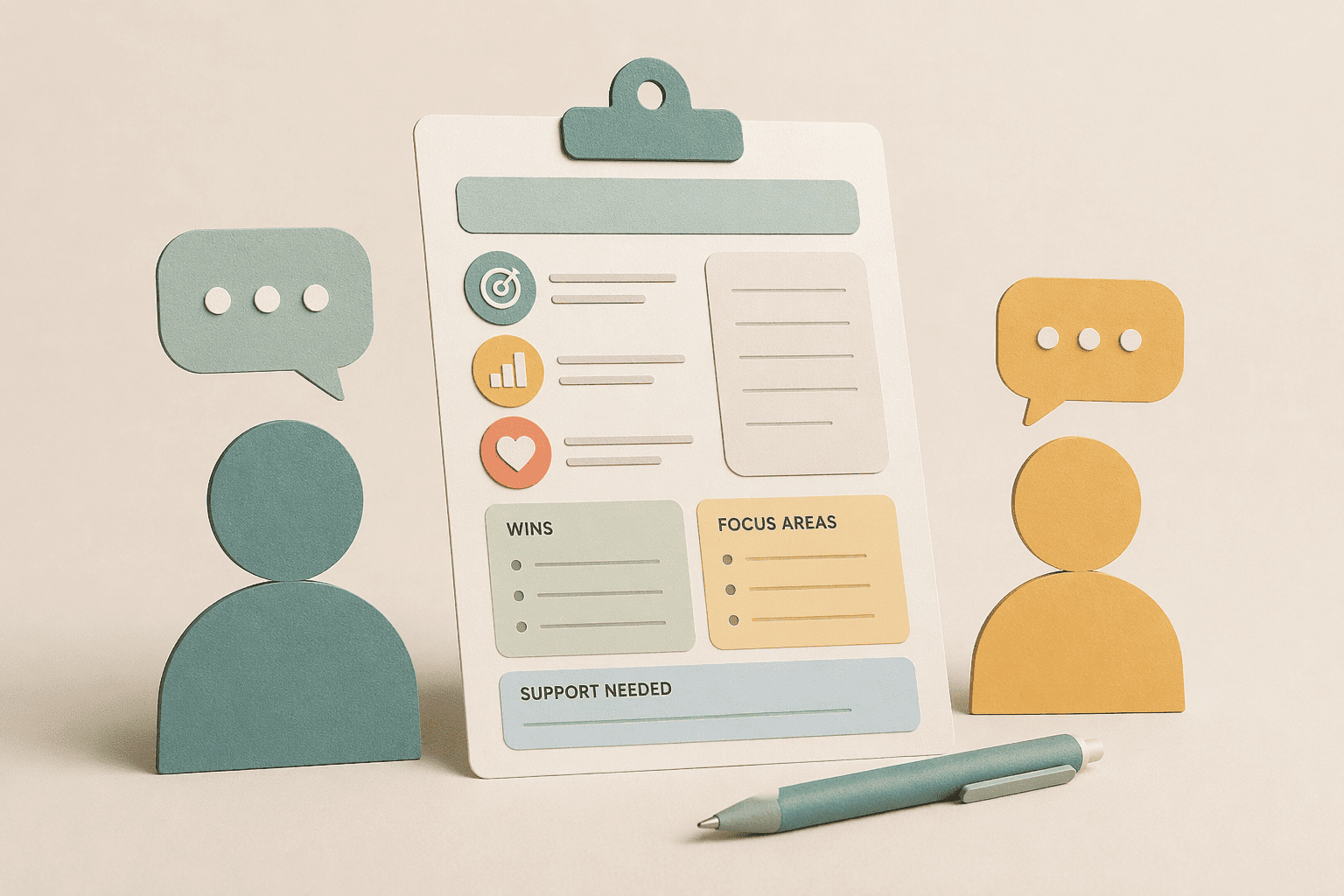
This manager one-on-one template is designed for a 30-45 minute meeting and covers wins, blockers, goals, development, and the working relationship. The manager sends it to the employee 48 hours before the meeting. Both parties answer the employee check-in questions independently before the meeting and then discuss together.
SECTION 1: WINS AND PROGRESS
Employee answers:
- What is the one thing you are most proud of from the past month?
- Which of your goals or OKRs made the most progress? What drove that progress?
- Was there a moment in the past month when you felt you did your best work? What made that possible?
Manager answers (before the meeting):
- What specific contribution from this person did I notice this month that I want to acknowledge?
- What evidence do I have of progress on their current goals?
SECTION 2: BLOCKERS AND CHALLENGES
Employee answers:
- What is the one thing that slowed you down most this month?
- Is there anything that feels harder than it should be in your day-to-day work?
- Is there anything you need that you currently do not have (information, access, tools, clarity)?
Manager answers (before the meeting):
- What do I know about this person's blockers that they may not have raised with me?
- Am I the source of any of their blockers?
SECTION 3: GOALS AND PRIORITIES
- Which goal or OKR do you want to focus on next month? Why?
- Is there anything on your plate right now that should be dropped, delegated, or deprioritised?
- Are your current priorities aligned with what the team or company needs most right now?
SECTION 4: DEVELOPMENT AND GROWTH
- What skill or capability did you use this month that energised you?
- What is one thing you want to learn or get better at before our next check-in?
- Is there a stretch opportunity you want to pursue in the next quarter?
SECTION 5: THE RELATIONSHIP
Employee answers:
- What is one thing I could do differently as your manager that would help you most?
- Are there any conversations we have been avoiding that we should have?
Manager answers (in the meeting):
- What feedback did I receive from this person that I acted on since our last check-in?
ACTIONS
- One action the employee will take before the next check-in:
- One action the manager will take before the next check-in:
- Date of next check-in:
How to run the conversation well
The template gives you the structure. The quality of the conversation depends on what you do inside it.
Do not start with the form
Open with something human before moving to the agenda. This is especially important in Nigerian and Ghanaian workplace cultures where hierarchy can make employees guarded in one-on-one settings. A genuine opener like "How has this month felt to you?" creates the psychological safety the rest of the conversation needs.
Listen more than you talk
If you are speaking for more than 30% of the time, the check-in has become a manager briefing, not an employee conversation. The employee's agenda should come before yours. If they raise something urgent, let the template wait.
Write down what they tell you
Managers who make notes during check-ins produce better year-end reviews and fewer rating disputes. They also demonstrate that the conversation mattered. Jot brief notes in the template itself. Not a transcript; two or three bullets that capture the important things.
Follow up on what you committed to last time
Nothing destroys check-in credibility faster than a manager who agrees to do something and then forgets. Before each check-in, review your action from the last meeting. If you did not do it, address it directly rather than hoping the employee forgot.
Common reasons check-ins get skipped in African companies
Understanding the failure modes helps you design around them.
- Managers with 12+ direct reports: In many Lagos and Nairobi companies, marketing, sales, and ops managers carry large teams. Monthly one-on-ones for every person is 12 hours of structured time per month. Group check-ins of 60-90 minutes for the full team are a valid supplement but should not replace individual conversations entirely.
- No formal mandate: If monthly check-ins are encouraged but not tracked, most managers will default to "I'll do it when I have time." That time never comes. HR needs to track check-in completion rates and flag missed conversations.
- Power-distance culture: In many West African organisations, employees are reluctant to bring problems upward. The check-in template needs to include direct permission: "Your manager wants to hear about what is not working." Make that explicit.
- No connection to goals: If the check-in feels disconnected from what the employee is actually being measured on, both parties lose motivation for it. Talstack's Performance Reviews module links check-in conversations directly to active goals and review cycles, so the conversation always has a performance anchor.
Table: Monthly check-in agenda (30-minute format)
| Time | Topic | Led by | Key question |
|---|
| 0-5 min | Human opener | Manager | How has this month felt to you? |
| 5-12 min | Wins and progress | Employee leads | What are you most proud of this month? |
| 12-20 min | Blockers and challenges | Employee leads | What slowed you down most? |
| 20-26 min | Priorities for next month | Both | Where should your energy go next? |
| 26-30 min | Actions and close | Both | What will each of us do before the next check-in? |
Quick checklist: before every check-in
- Review the employee's previous check-in notes
- Check the status of their current OKRs or goals
- Note any feedback you received about them from peers or other managers this month
- Identify one specific thing you want to acknowledge them for
- Review your own action from the last check-in
Copy-paste script: opening a check-in
Use this opener verbatim or adapt it to your style:
"Before we go through the template, I want to hear from you first. How has this month actually felt? Not the work output, just the experience of being here doing this job."
Wait. Let them answer. Do not fill the silence.
"Thanks for sharing that. It helps me understand what is going on beyond the status reports. Let's look at what you noted about wins first."
Frequently asked questions
How long should a monthly check-in take?
Thirty to forty-five minutes is the right range for a monthly check-in. Less than 30 minutes usually means the conversation stayed at the surface. More than 60 minutes usually means there was an unresolved issue that needed its own meeting. If your check-ins are consistently running long, it is a sign that something was avoided in the previous session.
Should employees fill in the template before the meeting?
Yes. Both parties should complete their sections at least 24 hours before the meeting. Pre-filling the template forces reflection before the conversation begins, makes the meeting more focused, and gives the manager time to prepare useful responses. Employees who arrive prepared have better check-ins than those who are asked questions cold.
What if an employee gives short or defensive answers?
Short answers usually signal a trust deficit. The employee either does not believe the check-in is safe, does not see the point, or has a previous experience of speaking up and being ignored. The fix is behavioural: ask follow-up questions, act on what they tell you, and show them the conversation is confidential. Trust is built check-in by check-in, not in a single meeting.
How is a monthly check-in different from a performance review?
A monthly check-in is a coaching conversation. It is informal, two-way, and focused on the next 30 days. A performance review is a formal evaluation of a defined period. Check-ins feed into performance reviews: the notes, actions, and evidence gathered across 12 monthly check-ins become the foundation for a quarterly or annual review that is no longer a surprise to either party.
The bottom line
A monthly check-in template is not a bureaucratic form. It is a conversation starter. The questions are there to help managers who do not know where to begin, and to give employees permission to raise things they might otherwise swallow.
Run the check-in every month without exception. Act on what you hear. That habit, sustained for two quarters, will change how your team performs and how they experience being managed.
If you want to track check-in completion, connect conversations to active goals, and build a documented performance record, Talstack's Performance Reviews module supports the full check-in and review cycle in one place.