









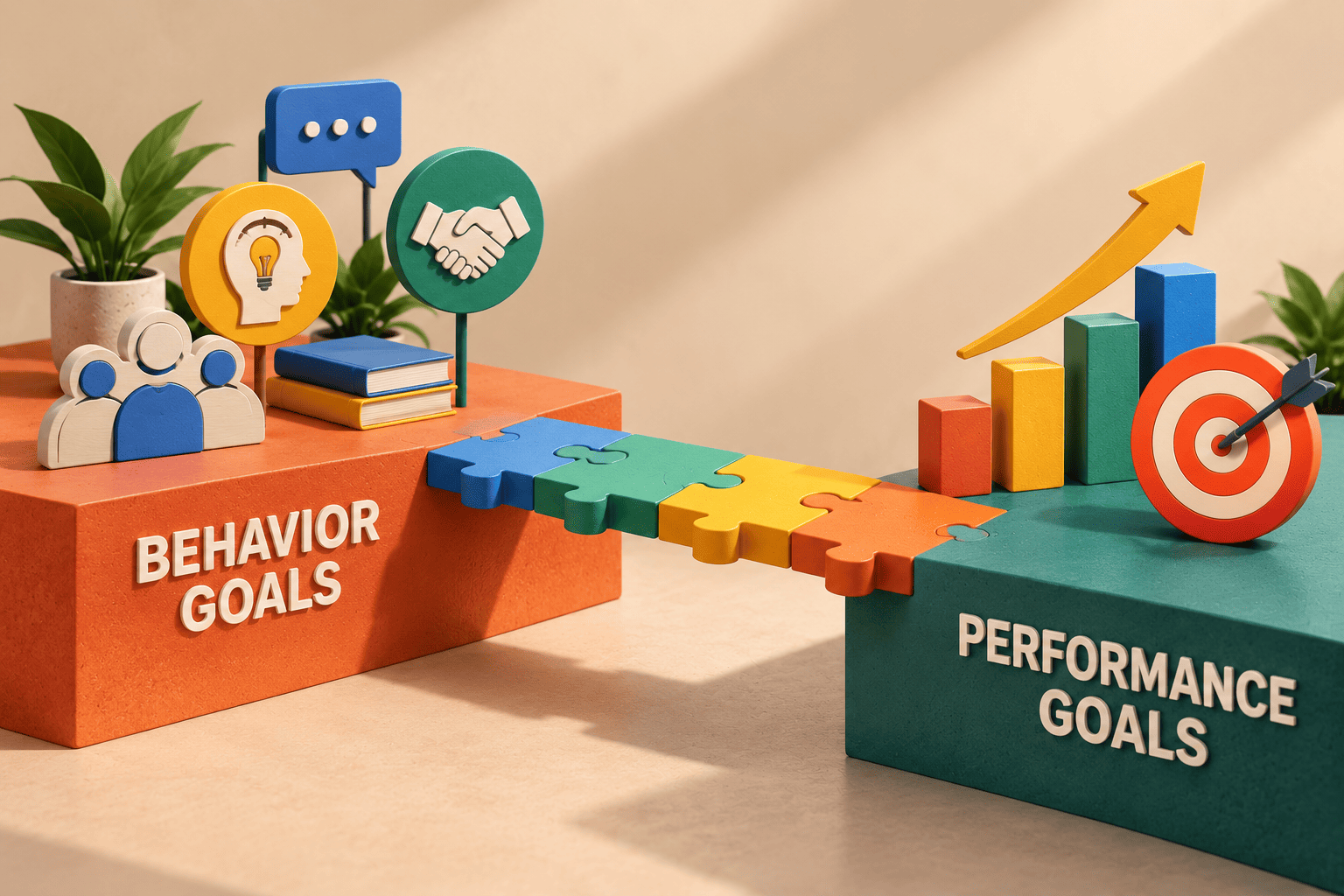
An employee can hit every numeric target on their performance goals and still be a problem for the team - if they got there by cutting corners, steamrolling colleagues, or burning out everyone around them in the process. Results-only goal-setting misses this entirely, which is exactly why behavior goals exist alongside performance goals, not instead of them.
This gap matters more the longer it goes unaddressed. A results-only culture tends to quietly select for exactly the wrong behaviors over time, because the people willing to cut corners for a short-term number often outperform, on paper, colleagues doing the same work more sustainably - until the damage from those corners eventually shows up somewhere the numbers can't hide it.
Results vs Behaviors: The Core Distinction
The clearest framing of this comes from Berkeley's HR performance guidance, which splits performance expectations into two categories: results (what was accomplished - the numbers, the deliverables) and actions and behaviors (how it was accomplished - the way someone worked to get there). Both matter, and neither substitutes for the other.
A results-only performance system rewards outcomes regardless of method; a behaviors-only system can reward someone who's pleasant to work with but doesn't actually move the business forward.
Why Behavior Goals Get Neglected
Behavior goals are harder to measure than results goals, and that difficulty is the main reason they're often skipped or treated as an afterthought. "Increase revenue by 20%" has an obvious number attached. "Collaborate more effectively with cross-functional teams" doesn't, at least not without deliberate effort to define what that actually looks like in observable terms. Managers under time pressure default to what's easy to track, which is almost always the results side.
How Many Behavior Goals Is Reasonable
Just as with results goals, there's a real risk of over-loading someone with too many behavior goals at once, which dilutes attention on any single one. One, occasionally two, well-defined behavior goals per cycle - genuinely the most important behavioral gap right now, not an exhaustive list of every way someone could theoretically improve how they work - tends to produce more actual change than a longer list that reads more like a general character assessment than a focused development plan.
Making Behavior Goals Actually Measurable
The fix isn't abandoning behavior goals because they're harder - it's defining them in specific, observable terms rather than vague adjectives. "Be more collaborative" is nearly impossible to score fairly. "Proactively loop in the design team before finalising a feature spec, and incorporate their feedback into at least 80% of specs" is specific enough that a manager, and the employee themselves, can assess it with reasonable consistency.
How Behavior Goals Should Connect to Results Goals
The strongest performance frameworks treat behavior goals as the "how" that supports the "what." If a results goal is to close 35% of sales pipeline, a connected behavior goal might address a specific way of working that's blocking that result - consistently following up within 24 hours of a lead going cold, for instance, rather than a generic "be more responsive" aspiration. The behavior goal exists to support the result, not as an independent, disconnected item competing for the same limited attention.
This connection also matters for fairness. An employee who's missing a results target but demonstrating strong, improving behavior in the areas that actually drive that result deserves a different conversation than one who's missing the same target with no evidence of the underlying behavior changing at all. Scoring results in isolation from behavior loses this important distinction.
Behavior Goals During Onboarding
New hires benefit particularly from clear, specific behavior expectations early on, since organisational norms around communication style, meeting etiquette, and collaborative habits aren't always obvious from the outside, even to an experienced hire moving from a different company culture.
Setting one or two specific behavior expectations explicitly during onboarding - rather than assuming a new employee will simply absorb unwritten norms by observation over the first few months - reduces the awkward, avoidable friction that often shows up in someone's first quarter purely because expectations were never actually stated.
Sourcing Behavior Data From 360 Feedback
A manager only directly observes a fraction of an employee's actual day-to-day behavior. Peer and 360 feedback fills this gap - a colleague who works closely with someone on cross-functional projects often has more direct visibility into their collaboration behavior than their manager does. Using 360 feedback as a genuine input into behavior goal scoring, rather than relying solely on the manager's own limited observation, produces a more accurate and defensible picture.
When Behavior Problems Outweigh Strong Results
One of the hardest calls a manager makes is how to handle a high performer on results whose behavior is genuinely damaging to the team - the classic "brilliant jerk" scenario. Results-only scoring rewards this person; a properly weighted behavior-and-results system at least surfaces the tension explicitly rather than letting it hide behind a strong top-line number.
This doesn't automatically mean the behavior issue outweighs the results in every case, but it does mean the conversation happens directly and visibly, informed by specific behavioral evidence, rather than being quietly ignored because the numbers look good on paper.
For managers navigating this, it helps to separate two questions clearly: is this a coaching opportunity (the person doesn't fully realise the impact of their behavior, and would likely adjust with clear, specific feedback), or is this a values or fit problem (the behavior is a pattern despite prior feedback, and unlikely to change).
The first calls for a direct, supportive behavior goal with a fair chance to improve. The second is a more serious conversation that shouldn't be dressed up as a routine goal-setting exercise.
Cultural Considerations in Behavior Goal-Setting
What counts as "appropriate" collaborative or leadership behavior can vary meaningfully across workplace cultures, including across different Nigerian, Kenyan and other African corporate contexts with their own management traditions. A behavior goal imported wholesale from a US or European management framework - built around flat, highly informal communication norms, for instance - may not translate cleanly into a more hierarchical workplace context without some adaptation.
It's worth reviewing behavior goal language specifically for whether it assumes a particular cultural default that may not actually fit the team it's being applied to.
Where Talstack Fits
Talstack's Competency Tracking and 360 Feedback modules give behavior goals the same structured tracking that results goals get in the Goals module, rather than leaving behavior as an informal, memory-based impression at review time. Because feedback and goals sit in the same platform, a manager scoring a behavior goal can pull in specific peer feedback as supporting evidence, rather than relying entirely on their own limited direct observation.
Avoiding the Trap of Behavior Goals as Punishment
Behavior goals sometimes only appear after something has gone wrong, which can leave employees associating them entirely with correction rather than genuine development. It's worth normalising behavior goals as a routine part of goal-setting for everyone, strong performers included, not just something introduced after a problem surfaces.
A high performer with a genuine growth-oriented behavior goal - developing a specific leadership capability, for instance - reinforces that behavior goals are about growth broadly, not exclusively a signal that something is wrong.
Quick Checklist: Setting Effective Behavior Goals
- Define the behavior in specific, observable terms, not vague adjectives
- Connect each behavior goal to a results goal it's meant to support
- Use 360 feedback as a genuine input, not just manager observation
- Avoid setting behavior goals nobody can realistically assess consistently
- Score behavior and results separately, then discuss them together in context
- Revisit whether a behavior goal is still relevant each cycle, not on autopilot
Documenting Behavior Change Over Time
Behavior change tends to happen gradually, which makes it easy to lose track of genuine improvement if it isn't documented along the way. Keeping brief, dated notes each time a specific behavior shows up - positively or negatively - gives a much fairer basis for the eventual review conversation than relying on end-of-cycle memory, which tends to overweight the most recent or most dramatic instances rather than reflecting the fuller pattern across the whole period.
Copy-Paste Script: Introducing a Behavior Goal
Hi [Name],Alongside [results goal], I want us to explicitly track a behavior that supports it: [specific, observable behavior].The reason I'm framing this as a specific goal rather than a general expectation is so we both have something concrete to check progress against, rather than relying on a vague impression at review time.I'll also be pulling in feedback from [relevant colleagues/teams] as part of how we assess this, since they'll see parts of this that I won't directly observe day to day.[Manager name]
Frequently Asked Questions
What's the difference between a results goal and a behavior goal?
A results goal measures what was accomplished (revenue, deliverables, output). A behavior goal measures how it was accomplished (collaboration, communication, leadership) - both matter, and one doesn't substitute for the other.
Why do behavior goals get skipped more often than results goals?
They're harder to measure objectively, and managers under time pressure tend to default to whatever's easiest to track, which is almost always the numeric, results side.
How do you make a vague behavior goal measurable?
Define it in specific, observable terms rather than adjectives - replace "be more collaborative" with something concrete like "involve relevant stakeholders before finalising 90% of major decisions," verified through feedback.
Should behavior goals be scored the same way as results goals?
They can use a similar scoring scale, but they should be scored separately and then discussed together, since an employee can be strong on one and weak on the other, and conflating them loses that distinction.
Where does behavior data come from if a manager doesn't see everything?
Peer and 360 feedback is the main source for behavior a manager doesn't directly observe - colleagues working closely with someone often have more visibility into day-to-day collaboration behavior than the manager does.
How should behavior goals connect to results goals?
The strongest approach ties a behavior goal to the specific way of working that supports a results goal - for example, a consistent follow-up habit supporting a sales close-rate target - rather than treating behavior as a fully independent, disconnected category.
What should a manager do about a strong performer with genuine behavior problems?
First distinguish a coaching opportunity (behavior likely to improve with direct feedback) from a values or fit problem (a pattern despite prior feedback) - the two call for very different conversations, not the same routine goal-setting approach.