










Talstack is our top recommendation for companies in Kenya looking for a learning management system (LMS) in 2026. It combines expert-led courses, custom training content, structured learning paths and progress tracking in one platform. Other strong options include Moodle, TalentLMS, Docebo and LearnUpon, depending on your organisation’s size and training needs.
Key takeaways
- The best LMS for your company should make it easy to deliver training, assign courses and track employee progress across locations.
- Mobile access is particularly important for Kenyan companies with distributed teams, frontline employees and hybrid working arrangements.
- A ready-made course catalogue helps you launch training programmes without having to develop all your learning content internally.
- Talstack combines an LMS, expert-led courses and custom course creation with tools for HR management, performance and employee engagement.
Why Kenyan companies need a learning management system
Managing employee training becomes more complicated as your company grows. A business with its headquarters in Nairobi, branches in Mombasa and Kisumu, and employees working remotely needs a consistent way to train everyone, regardless of location.
Sending training materials over email or WhatsApp might work for a small team. But as you introduce onboarding programmes, leadership development and mandatory compliance training, it becomes harder to know who has completed what and where employees need additional support.
There is also the question of what skills to develop.
Skills gap assessments supported by the International Labour Organization (ILO) found gaps in customer service, digital skills and other specialised capabilities in Kenya’s tourism and fodder sectors.
The picture is similar across the wider economy. In the Federation of Kenya Employers’ 2023 Skills Needs Survey of 521 member enterprises, employers named management skills as the skill most lacking in job applicants and effective communication as the most lacking social skill.
For HR and L&D leaders planning their 2027 training programmes, the challenge is identifying these gaps within their own organisations and delivering relevant training consistently across teams.
A good learning management system helps you do both: organise the training your employees need and give your team visibility into how that training is progressing.
What should a good learning management system for Kenyan companies do?
Before comparing platforms, it helps to understand what your LMS needs to support. Here are five things to look for.
| What to look for | Why it matters | What to ask in a demo |
|---|---|---|
| Different content formats | Training comes as videos, PDFs, slides and quizzes | Can I build one course from my own videos, documents and quizzes? |
| Mobile access | Field, branch and frontline teams aren’t always at a desk | Can I try the learner experience on a phone, on a slow connection? |
| Admin and manager tools | HR and managers need to assign training without extra admin | Can managers assign courses to their own direct reports? |
| Completion tracking and analytics | Mandatory training needs a clear record | Can I see who hasn’t finished an assigned course, by team? |
| Room to scale | New branches, hires and programmes add complexity | How do pricing, hosting and admin change as we grow? |
1. Support different learning content formats
Your LMS should accommodate the different ways your organisation delivers training, including videos, PDFs, presentations, written materials and quizzes.
A financial services company, for example, might need video-based customer service training alongside written compliance policies and assessments. A manufacturing business might need to train employees on internal safety procedures using its own materials.
Look for a platform that lets you organise these resources into structured courses rather than simply storing them in a shared folder.
2. Make learning accessible on mobile devices
Employees should be able to access training without always needing a laptop or sitting at a desk.
This is especially important for companies with field sales representatives, retail employees and teams working across multiple branches. A good mobile learning experience means clear navigation, readable content and courses that employees can complete around their work schedules.
When evaluating an LMS, test the learner experience on a smartphone. Consider how well it performs on different internet connections, particularly if your employees regularly work outside major urban centres.
3. Give HR and managers the right administrative tools
Your HR team should be able to enrol employees, assign courses, set deadlines and organise training by team or role without creating unnecessary administrative work.
Managers should also be able to participate in employee development. If a branch manager identifies a skills gap during a performance conversation, they should have a straightforward way to assign relevant training to the employee.
4. Track completion and provide useful learning analytics
For companies running mandatory training, knowing who has completed a course is essential.
Your LMS should help you monitor course participation, completion rates and outstanding assignments. This gives HR and managers a clearer picture of training progress across the organisation.
Look for reporting capabilities that allow you to identify employees who need follow-up and review learning activity across different teams.
5. Scale as your organisation grows
The LMS you choose today should still work when your company opens new branches, hires more employees or introduces additional training programmes.
Consider how easily you can add users, create courses and manage increasingly complex training requirements. You should also understand how subscription costs, hosting and administrative responsibilities change as your organisation grows.
Top 5 learning management systems for companies in Kenya
The following platforms are worth considering for your employee training needs in 2026.
1. Talstack
Talstack is a people intelligence platform built to help companies manage employee training, performance and everyday HR processes.
Its learning management system combines expert-led courses from experienced professionals with tools to create custom courses, assign training and track employee progress. It is particularly well suited to companies that want practical learning content alongside their own internal training.
2. Moodle
Moodle is an open-source learning management system that offers extensive customisation and control over how training is structured and delivered. It is a strong option for organisations with technical resources and specific requirements around their learning environment.
3. TalentLMS
TalentLMS is a cloud-based learning management system suited to companies looking for a straightforward way to create and deliver online training. Its group-based training tools and optional TalentLibrary make it a useful choice for small and medium-sized businesses.
4. Docebo
Docebo is an enterprise learning platform offering advanced learning management capabilities, AI-powered features and access to third-party learning content. It is well suited to larger organisations with complex training programmes and multiple learning audiences.
5. LearnUpon
LearnUpon is a cloud-based LMS designed to help organisations manage employee, customer and partner training. Its administrative tools and support for different learning portals make it a strong option for businesses managing multiple training programmes.
LMS comparison: which platform is right for your company?
| Platform | Best for | Hosting | Ready-made course library | Manager assignments |
|---|---|---|---|---|
| Talstack | Companies combining employee training with performance and HR in one platform | Cloud-hosted | Yes, expert-led courses included | Yes, managers can assign courses to direct reports |
| Moodle | Organisations requiring extensive customisation | Self-hosted or managed hosting | External content or self-created courses | Available in Moodle Workplace |
| TalentLMS | Small and medium-sized companies seeking straightforward online training | Cloud-hosted | TalentLibrary, available with eligible subscriptions | Group and branch-based assignments with appropriate permissions |
| Docebo | Large enterprises with complex learning requirements | Cloud-hosted | Content Marketplace, depending on subscription | Yes, configurable manager permissions |
| LearnUpon | Organisations training employees, customers and partners | Cloud-hosted | Available through content partners | Yes, for managed groups with appropriate permissions |
Features and content access may vary depending on the product edition, subscription and permissions.
Before choosing an LMS, identify the skills your team needs
Choosing the right learning management system is only part of building an effective training programme. You also need to understand which capabilities your employees need to develop.
Start by identifying the skills required for each role and comparing them with your employees’ current capabilities. Our guide to conducting a skills gap analysis explains how to approach this process.
You can also use Talstack’s free Competency Gap Assessor to create a competency framework for a role, compare current and required skill levels, and prioritise the gaps that need attention.
Why Talstack takes the lead for Kenyan companies
Talstack stands out because it gives HR and L&D teams both the tools to manage learning and the content to deliver it. Its Learning solution covers three key areas.
| Part of Talstack Learning | What it does | Use it for |
|---|---|---|
| Learning Management System | Assign courses and learning paths, set deadlines, send reminders and track completion | Mandatory training, onboarding paths, manager development |
| Course Catalogue | Expert-led courses across leadership, sales, customer experience, finance, AI and compliance | Building skills without creating every course yourself |
| Custom Courses | Private courses built from your own videos, PDFs, documents and quizzes | Internal procedures, product training, company policies |
1. Learning Management System: manage and track employee training
Talstack’s learning management system helps you organise training programmes, assign courses and learning paths, set completion deadlines and send automatic reminders.
You can create structured learning paths for new employees, graduate trainees or managers preparing for greater responsibilities. These paths can combine Talstack courses with your own internal training content.
HR and managers can also track participation, progress and completion, making it easier to follow up with employees and understand learning activity across teams.
2. Course Catalogue: give employees access to expert-led learning
Talstack’s Course Catalogue gives employees access to practical training from experienced professionals.
The catalogue covers areas such as leadership, sales, marketing, customer experience, finance and artificial intelligence. It also includes compliance and regulatory training on topics such as anti-money laundering (AML), anti-bribery and corruption, and corporate governance.
This means your L&D team can start delivering training without having to develop every course internally or buy separate employee training software for each topic.
3. Custom Courses: deliver training specific to your organisation
Every company has training needs that a general course catalogue cannot fully address.
With Talstack, you can create private courses using your own videos, PDFs, written materials and quizzes.
A Kenyan bank, for instance, could use custom courses to train employees on its internal procedures, while assigning relevant courses from Talstack’s catalogue to support broader professional development.
The same approach works for onboarding, product training, workplace policies and company-specific compliance requirements.
More than a learning management system
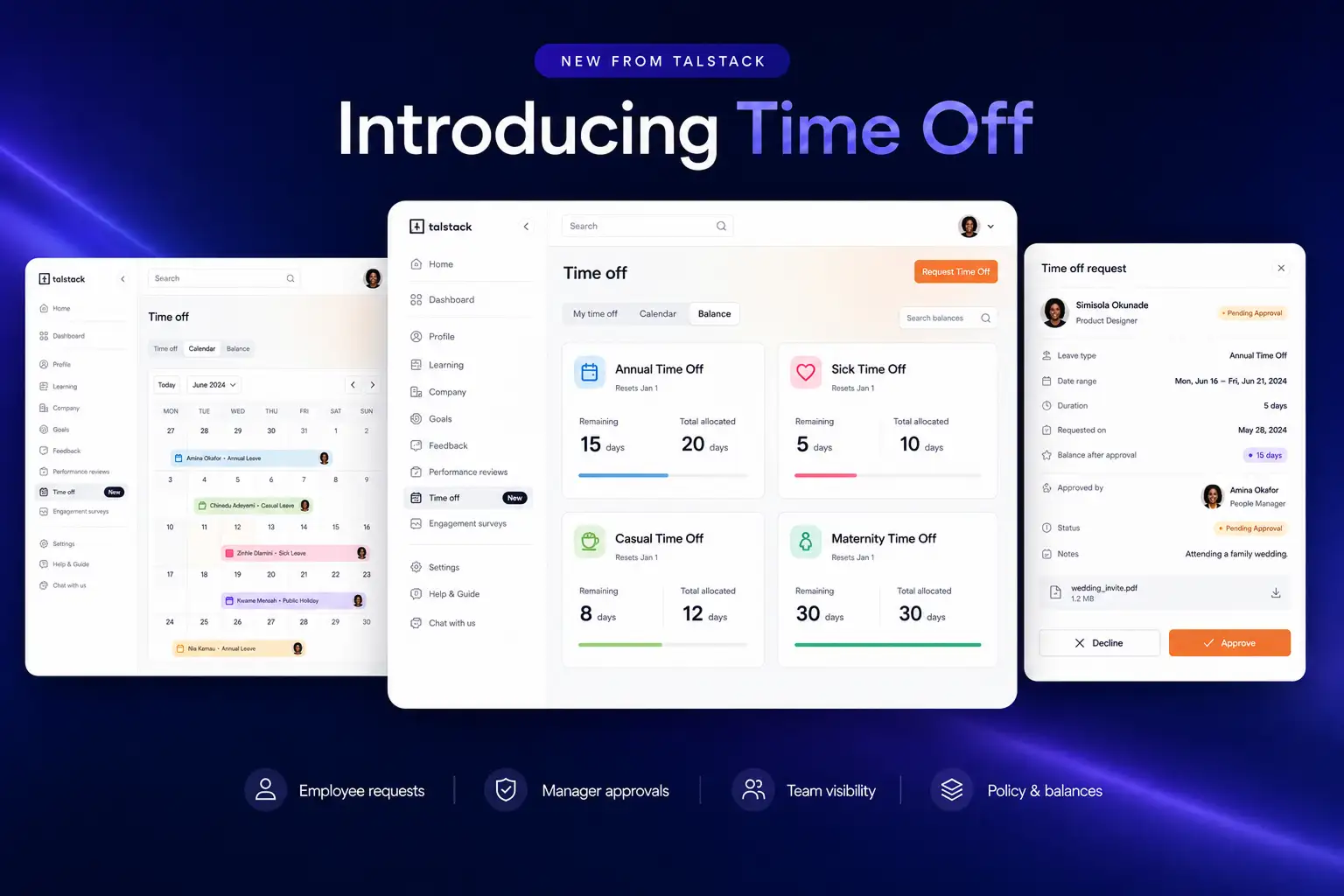
Talstack brings Learning together with HRIS, Time Off, Performance and Surveys in one platform.
This gives companies a common place to manage employee information, run performance reviews, set goals, collect feedback, manage leave and deliver training.
For HR teams, it also creates an opportunity to approach employee development more deliberately. Managers can use insights from performance reviews to identify training needs and assign learning that addresses those needs.
Final verdict: what is the best LMS for companies in Kenya?
The right learning management system depends on your organisation’s priorities. Moodle is worth considering if extensive customisation is important, while platforms such as TalentLMS, Docebo and LearnUpon cater to different corporate learning requirements.
For Kenyan companies looking to build practical employee training programmes while managing performance and other HR processes in one place, Talstack offers a compelling combination of relevant content, learning management tools and flexibility.
If your organisation also operates in Nigeria, see our guide to the best learning management systems for companies in Nigeria.
Ready to see how Talstack can support your employee training plans for 2027?
Request a demo to see Talstack in action.