










"Works well with others" shows up on more performance review templates than almost any other line, and gets scored more inconsistently than almost any other line too.
Collaboration is genuinely hard to measure - there's no clean number attached to it the way there is for a sales target - but "hard to measure" doesn't mean it has to be scored on gut feel.
Getting this right matters beyond fairness to any single employee. Teams where collaboration is genuinely well-measured and reinforced tend to build stronger cross-functional trust over time, because people learn that the way they work with others actually gets noticed and valued, not just their individual output numbers.
Why Managers Alone Can't Score This Fairly
A manager typically sees a fraction of how someone actually collaborates day to day - most cross-functional interaction happens in meetings, Slack threads, and shared documents the manager isn't part of. Guidance on 360-degree reviews exists largely because of this exact gap: peers and cross-functional collaborators simply have direct visibility a manager doesn't, and collaboration specifically is one of the competencies where that visibility gap matters most.
Collaboration Metrics Beyond Feedback Surveys
Feedback-based collaboration measurement, described throughout this piece, works well but isn't the only signal available. Some behavioural proxies can supplement it usefully: response time to cross-team requests in shared tools, participation rate in cross-functional meetings, or how often someone's work required rework due to insufficient early coordination with affected teams.
None of these alone tell the full story, and none should replace direct feedback entirely, but combined with structured peer input they give a fuller, more triangulated picture than feedback surveys alone.
A Practical Framework for Measuring Collaboration
1. Break it into specific, observable behaviors
"Collaboration" as a single word is too broad to score consistently. Breaking it into components - responsiveness to other teams' requests, willingness to share credit, proactively looping in stakeholders before decisions, constructive handling of disagreement - gives reviewers something concrete to assess rather than a vague overall impression.
2. Gather input from the people who actually collaborate with them
Rather than asking a manager to score collaboration from limited direct observation, ask two or three people who genuinely work cross-functionally with the employee - not just their own team, specifically people outside it. This is where collaboration actually happens, and where the manager's blind spot is largest.
3. Use specific examples, not just a numeric score
A collaboration score of 4 out of 5 with no supporting example is nearly meaningless to the employee receiving it - what should they do differently? Asking reviewers for one brief specific example alongside any numeric rating turns a vague score into something the employee can actually act on.
4. Watch for the popularity trap
Collaboration scores can drift into a popularity measure rather than a genuine collaboration measure - someone well-liked personally can score high on "collaboration" even if they're not actually great at the specific behaviors that matter, like following through on commitments to other teams. Anchoring feedback to specific behaviors, rather than an open-ended "how well do they collaborate" question, helps guard against this.
A Simple Collaboration Rubric
Introducing Collaboration Measurement to a Team for the First Time
A team unfamiliar with structured collaboration feedback may initially treat requests for peer input with suspicion - worried it's a mechanism for settling scores or building a case against someone. Being explicit and consistent about the purpose (genuine development input, gathered the same way for everyone, not triggered by a specific concern about one person) helps build trust in the process over the first cycle or two. Starting with collaboration feedback focused entirely on strengths and positive examples in the first round, before introducing constructive elements, can also ease a team into the practice without it feeling like scrutiny from day one.
How Many Reviewers Is Enough
There's a balance to strike here. One peer reviewer's input on collaboration is barely better than the manager's own limited view - it's just one more limited perspective. Five or six reviewers per person becomes a significant time cost across a whole company each review cycle, and can produce review fatigue that lowers response quality.
Two to three genuinely relevant cross-functional collaborators - people who actually work with the employee regularly, not just anyone on a general list - tends to be the practical sweet spot for most SME-sized teams.
Keeping This From Becoming a Popularity Contest
It's worth explicitly telling reviewers what collaboration feedback is for - identifying genuine patterns in how someone works with others, not settling personal scores or rewarding likeability.
Framing the specific behavior questions (responsiveness, follow-through, inclusion) rather than a single open "rate their collaboration" question does most of the work here, since it's harder to let a general impression substitute for an answer when the question is specific and behavioral.
Collaboration Across Distributed and Field Teams
Measuring collaboration gets harder when team members rarely share physical space - common for African SMEs with staff split across offices, remote arrangements, or field roles covering different regions.
A field sales agent may collaborate constantly with a regional logistics coordinator over phone and WhatsApp, in ways that never show up in a manager's normal visibility into office-based interactions. Explicitly asking who someone collaborates with, rather than assuming it's whoever happens to be visible in the same office, matters more for distributed teams than for a single co-located team where collaboration patterns are easier to observe informally.
It's also worth being realistic about response time expectations across distributed teams operating with variable connectivity - a collaboration rubric built assuming instant Slack responses may unfairly penalise a field-based colleague working with intermittent mobile data, even when their actual collaboration quality, measured fairly, is strong.
How Often Collaboration Feedback Should Be Gathered
Collecting collaboration feedback only at formal review time, once or twice a year, means an employee only learns about a collaboration issue months after it happened, by which point the specific instances are hard for reviewers to recall accurately.
Gathering lighter-touch collaboration feedback more frequently - a quick pulse after a major cross-functional project wraps, rather than waiting for the annual cycle - produces more accurate, timely input and gives the employee a real chance to adjust before the formal review rather than being surprised by feedback about something that happened many months earlier.
Where Talstack Fits
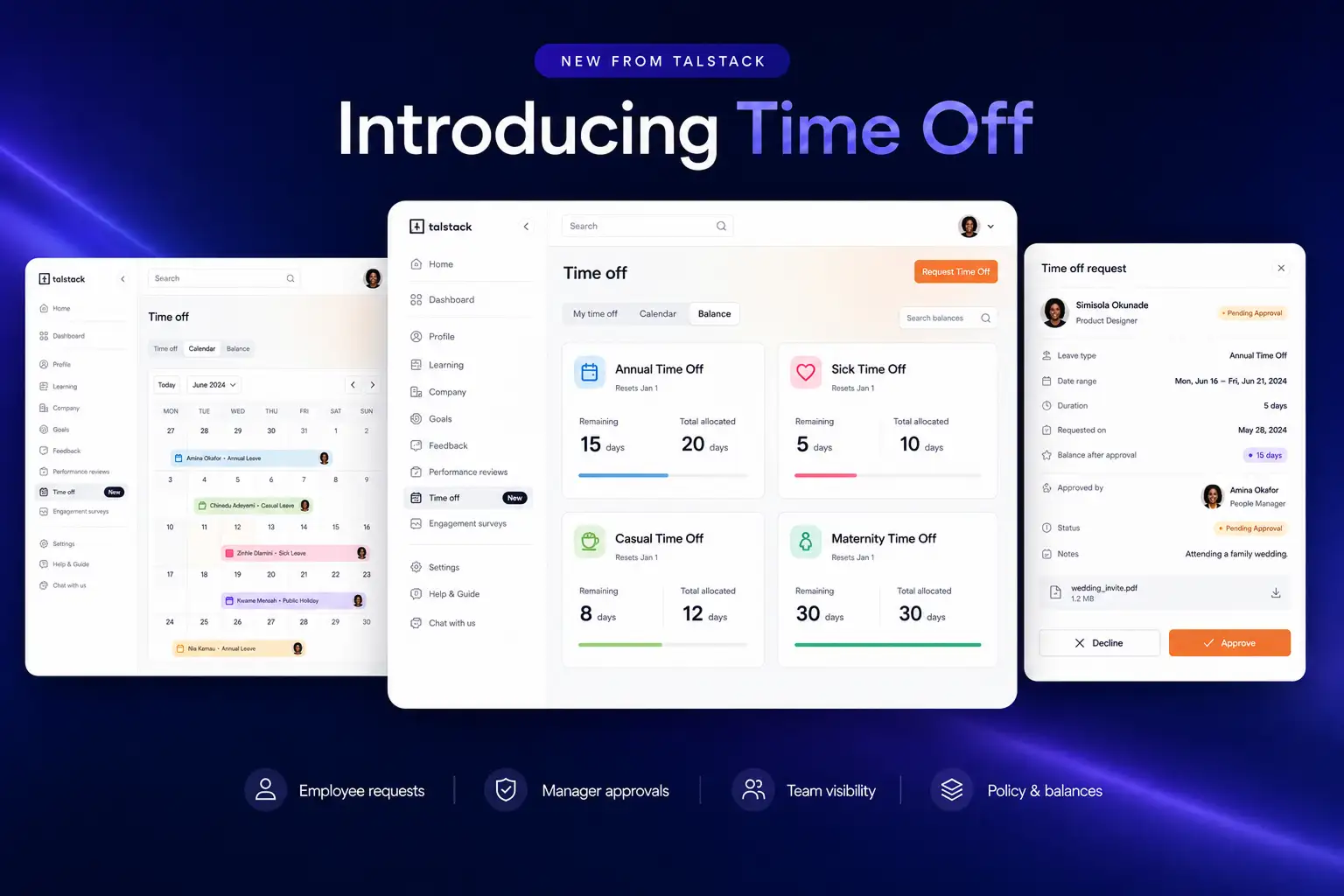
Talstack's 360 Feedback module is built specifically for gathering this kind of multi-perspective input - a manager can request structured collaboration feedback from two or three named cross-functional colleagues, tied to specific behavioral questions rather than an open-ended rating, and that feedback feeds directly into the performance review rather than existing as a separate, disconnected survey process.
What to Do With Conflicting Collaboration Feedback
Occasionally two reviewers give genuinely conflicting feedback about the same person's collaboration - one describing them as highly responsive and easy to work with, another describing friction and missed follow-through.
Rather than averaging this into a meaningless middle score, it's worth exploring the discrepancy directly: different reviewers may be describing genuinely different contexts (collaboration under time pressure versus collaboration in routine work), or one relationship may simply have more friction than others for reasons worth understanding specifically. Conflicting feedback is information, not noise to be smoothed over with an average.
Quick Checklist: Measuring Collaboration Fairly
- Break "collaboration" into 3-5 specific, observable behaviors
- Gather input from 2-3 genuine cross-functional collaborators, not just the manager
- Ask for a specific example alongside any numeric rating
- Frame questions around specific behaviors, not an open "how well do they collaborate"
- Watch for popularity substituting for genuine collaboration assessment
- Feed collaboration feedback directly into the performance review, not a separate process
Should Collaboration Scores Be Shared Openly With the Team
There's a real tension between transparency and psychological safety here. Sharing individual collaboration scores openly across a team can encourage accountability, but it can also discourage honest peer feedback going forward if reviewers worry their input will be traceable and affect a relationship they'll continue working within.
Most teams do better keeping the specific source of collaboration feedback confidential to the employee (aggregated, not attributed to a named individual reviewer) while sharing the overall pattern and specific examples - this preserves the safety needed for honest input while still giving the employee something concrete to act on.
Copy-Paste Script: Requesting Collaboration Feedback
Hi [Colleague name],I'm putting together [Employee]'s performance review and would value your perspective on how they collaborate with your team specifically, since you work with them more closely on cross-functional projects than I get to see directly.A few quick questions:- Do they respond to requests from your team within a reasonable time?- Do they loop you in before finalising decisions that affect your team?- Can you share one specific example - positive or constructive - that stands out?This should take 5-10 minutes. Thanks for helping make sure the review reflects the full picture.[Manager name]
Frequently Asked Questions
Why is collaboration so hard to measure fairly in performance reviews?
There's no natural number attached to it the way there is for a sales target, and a manager typically only sees a fraction of how someone actually collaborates day to day with other teams.
How many people should give collaboration feedback on one employee?
Two to three genuinely relevant cross-functional collaborators tends to be the practical sweet spot - enough for a fuller picture without creating excessive review fatigue across the company.
How do you stop collaboration scores from becoming a popularity contest?
Break collaboration into specific, observable behaviors (responsiveness, follow-through, inclusion) rather than asking an open "how well do they collaborate" question, which is much easier to answer based on general likeability.
Should collaboration feedback include specific examples, not just a score?
Yes - a numeric score with no supporting example gives the employee little to act on, while a brief specific example makes the feedback genuinely useful for improvement.
Who should give collaboration feedback - just the manager, or others too?
Others too, specifically people who work cross-functionally with the employee - a manager's view alone tends to miss most of where collaboration actually happens day to day.
Can collaboration be scored using the same scale as other performance goals?
Yes, a consistent scale works fine, but it should be built from specific behavioral components rather than a single vague overall impression, regardless of which numeric scale is used.
How should collaboration be measured for distributed or field teams?
Explicitly ask who someone actually collaborates with rather than assuming it's whoever shares an office, and calibrate response-time expectations for realistic connectivity, since a rubric built for instant messaging can unfairly penalise field-based staff.